Infantes E, de Smit J, Tamarit E, Bouma TJ
Limnology and Oceanography: Methods, 19: 317-330
Publication year: 2021

Abstract

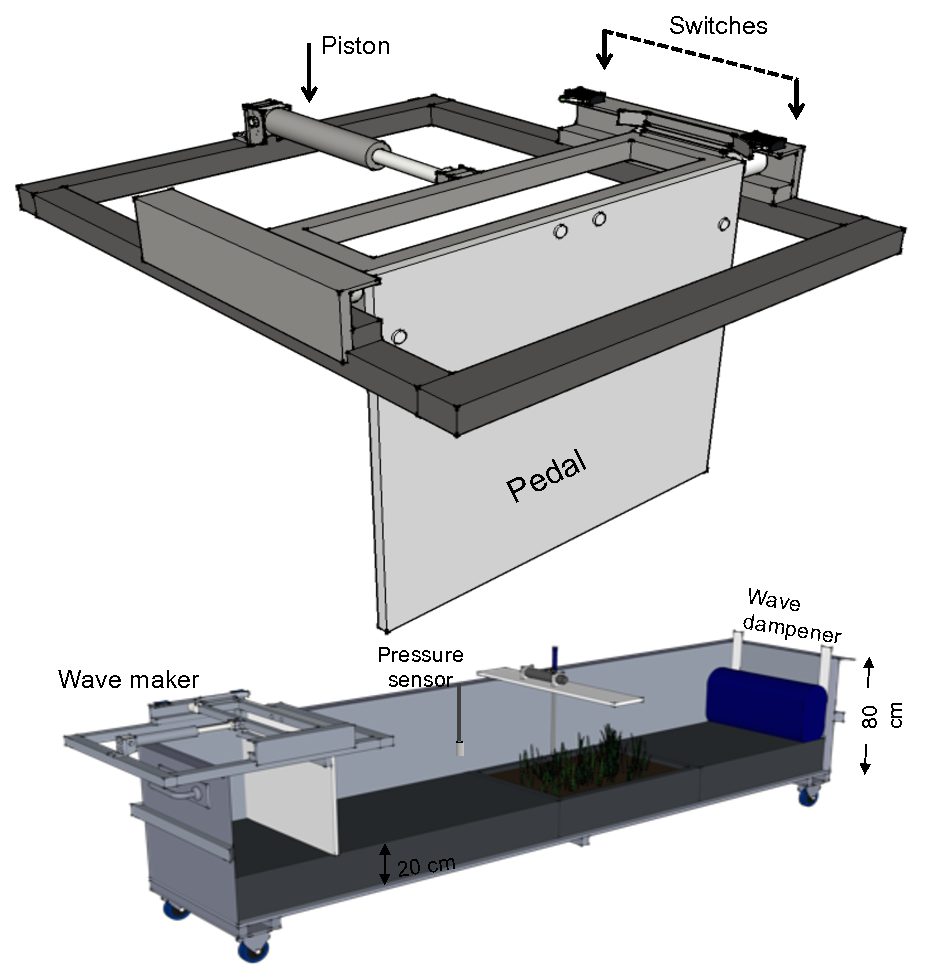
Wave flume facilities that are primarily designed for engineering studies are often complex and expensive to operate, and hence not ideal for long-term replicated experiments as commonly used in biology. This study describes a low-cost small wave flume that can be used for biological purposes using fresh or seawater with or without sediment.

The wave flume can be used as a mesocosm to study interactions between wave hydrodynamics and benthic organisms in aquatic ecosystems. The low-costs wave maker (less than 2000 USD) allows for experimental setups which can be easily replicated and used for longer-term studies; hence the term wave mesocosm. Waves were generated with a pneumatic piston and wave heights ranged between 3-6 cm. Maximum orbital flow velocities ranged between 10-50 cm s-1 representing shallow coastal areas with a short fetch.

The system can generate both regular waves (i.e., the wave period and orbital velocity remains constant), using a wave absorber, and irregular waves (i.e., varying wave period and orbital velocity) using a fast push and slow pull motion of the wave paddle. This wave mesocosm system is particularly useful in biogeomorphology to quantify interactions between organisms, sediment and hydrodynamics and for aquatic ecologist aiming to simulate realistic bed shear stress where short and long-term experiments (weeks-months) can be replicated.

Cire as: Infantes E, de Smit J, Tamarit E, Bouma TJ (2021) Making realistic wave climates in low-cost wave-mesocosms: a new tool for experimental ecology & biogeomorphology. Limnology and Oceanography: Methods, 19:317-330. DOI: 10.1002/lom3.10425

Highlights

  • A low-cost wave flume has been developed for biological studies.
  • The flume can use seawater or freshwater with or without sediment.
  • It can generate both regular and irregular waves using a pneumatic piston and wave paddle.
  • With wave heights ranging from 3-6 cm and maximum orbital flow velocities ranging from 10-50 cm s-1, the wave mesocosm can be used to study interactions between wave hydrodynamics and benthic organisms in aquatic ecosystems.
  • The system is particularly useful for biogeomorphology and aquatic ecology research to simulate bed shear stress.
  • Its low cost (less than 2000 USD) makes it ideal for long-term replicated experiments.

This article forms part of my research on hydrodynamics-seagrass interactions.

Learn how waves, currents, and sediment dynamics constrain seagrass persistence and resilience.

Further reading on seagrass ecology

Further reading on research carried at the flume

26. Role of eelgrass on bed-load transport and sediment resuspension under oscillatory flow

Journal Papers
Marin-Diaz B, Bouma TJ, Infantes E
Limnology and Oceanography, 65(2): 426-436
Publication year: 2020
The influence of hydrodynamics and ecosystem engineers on eelgrass seed trapping

22. The influence of hydrodynamics and ecosystem engineers on eelgrass seed trapping

Journal Papers
Meysick L, Infantes E, Boström C
PLoS ONE 14(9): e0222020
Publication year: 2019
eagrass roots of cymodocea nodosa eroding in cliff formation in sandy sediments Mallorca, Spain, Mediterranan sea

40. Seagrass roots strongly reduce cliff erosion rates in sandy sediments

Journal Papers
Infantes E, Hoeks S, Adams MP, van der Heide T, van Katwijk M, Bouma TJ
Marine Ecology Progress Series, 700:1-12, DOI: 10.3354/meps14196
Publication year: 2022
Microplastics threaten seagrass carbon sinks through microbial changes

59. Microplastics threaten seagrass carbon sinks through microbial changes

Journal Papers
Egea LG, Jiménez Ramos R, Rodríguez-Arias L, Infantes E
Marine Pollution Bulletin, 222(Pt 1):118638
Publication year: 2026

60. Successive stressors alter microbiome composition and reduce resilience in the eelgrass Zostera marina

Journal Papers
Egea LG, Jiménez-Ramos R, Rodríguez-Arias L, Infantes E
Marine Environmental Research: 107748, doi.org/10.1016/j.marenvres.2025.107748
Publication year: 2026