
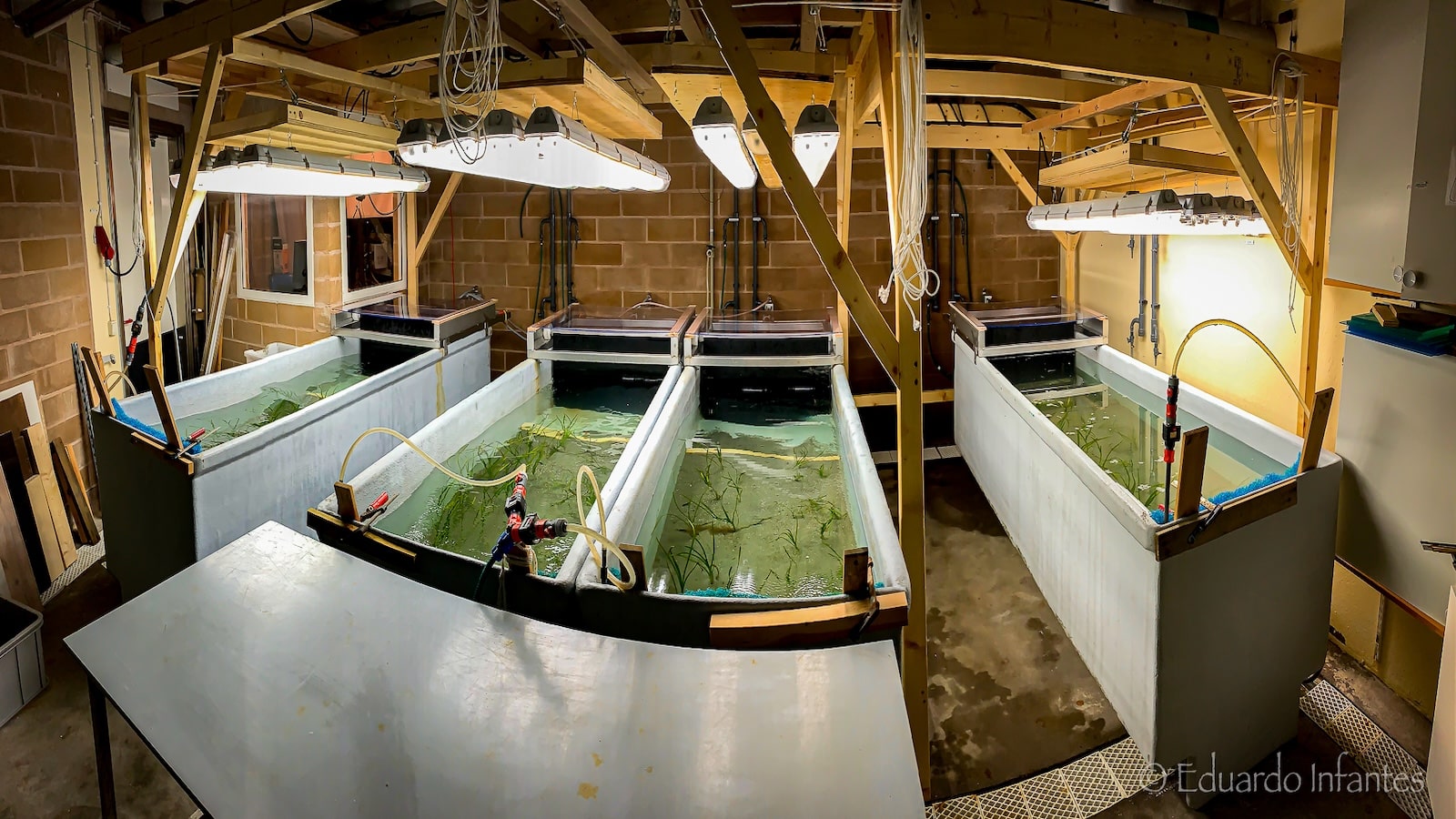
In March 2022, I presented the facilities available for seagrass culture at Kristineberg Marine Research Station to the Seagrass Nursery Network in a short 3-minute video. The presentation highlighted how the station’s infrastructure supports experimental seagrass research, seed-based restoration, and nursery development under controlled yet environmentally realistic conditions. Kristineberg provides a unique setting where field-based knowledge can be directly linked to experimental work on early seagrass life stages (see Reserch Theme: Seed-Based Seagrass Restoration).
The dominant seagrass species along the Swedish west coast is the eelgrass Zostera marina. Eelgrass grows mainly in wave-sheltered areas at depths of 1–5 m, where light availability and hydrodynamic conditions support meadow persistence. Several eelgrass meadows occur around Kristineberg, close to the research station. Researchers can collect plant material directly outside the piers by snorkeling or scuba diving. These meadows also host diverse invertebrate and fish communities, which play key roles in ecosystem functioning (see Blog: Life in an Eelgrass Meadow – The Hidden Fauna).
Kristineberg offers strong opportunities for both outdoor and indoor experiments using continuously pumped seawater from the fjord through flow-through systems. Outdoor tanks allow researchers to store flowering and reproductive shoots, facilitate seed release, and collect seeds for experimental studies or restoration trials. These facilities complement larger-scale hydrodynamic experiments conducted at the station, including flume studies that help explain how waves and currents influence seagrass establishment (see Blog: The Hydrodynamic Flume at Kristineberg – How It Works).
Indoor mesocosms provide a higher level of environmental control. Researchers use these systems to expose seeds and seedlings to different environmental drivers and stressors, including variation in light, temperature, pH, salinity, nutrients, and hydrodynamic forcing such as waves and currents. Wave mesocosms allow realistic simulation of near-bed flow conditions and help identify thresholds for seedling survival and anchoring (see Article: Wave Mesocosms for Seagrass Research).
Together, these facilities bridge field observations and controlled experiments. As a result, Kristineberg functions as a key node within the Seagrass Nursery Network, supporting mechanistic research on recruitment, early life-stage survival, and the development of effective, scalable restoration strategies.
Further reading on seagrass ecology


Related research articles conducted in the mesocosm


40. Seagrass roots strongly reduce cliff erosion rates in sandy sediments


Leave a Reply