de los Santos C, Krång A-S, Infantes E
Environmental Pollution, 269: 116050
Publication year: 2021
Microplastic retention by marine vegetated canopies: Simulations with seagrass meadows in a hydraulic flume
Carmen de los Santos collecting samples of Zostera marina seagrass at Kristineberg marine station, Sweden.
Carmen de los Santos collecting samples of seagrass Zostera marina

Abstract

Marine canopies formed by seagrass and other coastal vegetated ecosystems could act as sinks of microplastics for being efficient particle traps. Here we investigated for the first time the occurrence of microplastic retention by marine canopies in a hydraulic flume under unidirectional flow velocities from 2 to 30 cm s-1.

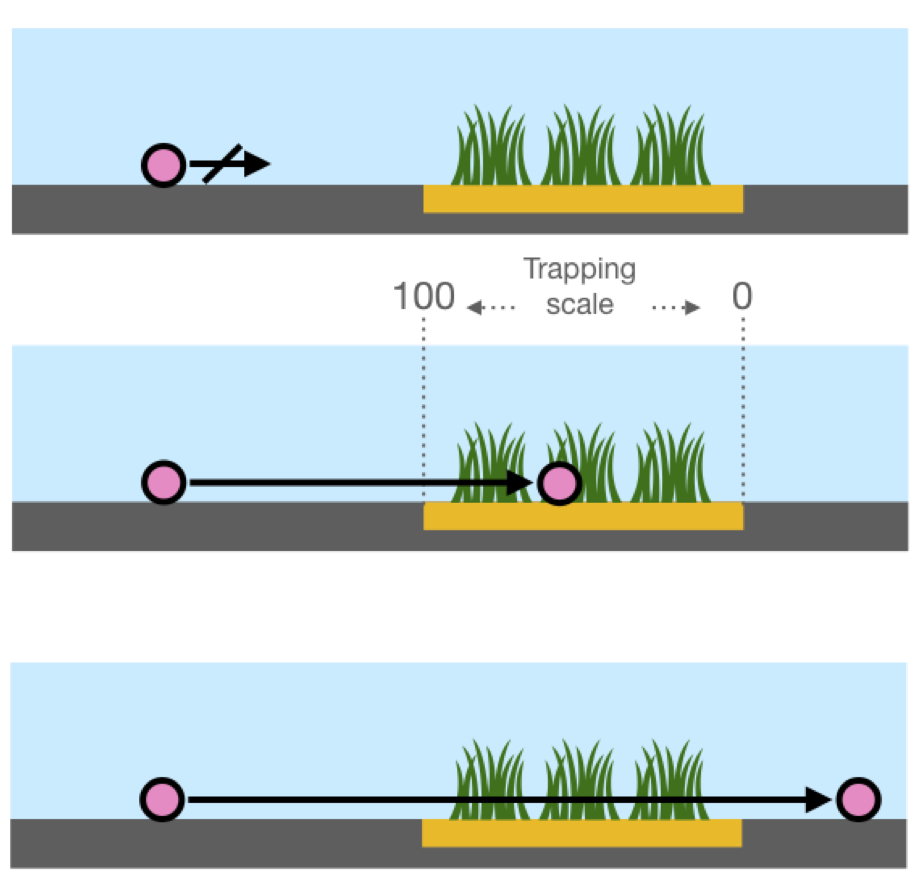
We used as model canopy-forming species the seagrass Zostera marina with four canopy shoot density (0, 50, 100, 200 shoots m-2), and we used as microplastic particles industrial pristine pellets with specific densities from 0.90 to 1.34 g cm-3 (polypropylene PP; polystyrene PS; polyamide 6 PA; and polyethylene terephthalate PET). Overall, microplastics particles transported with the flow were retained in the seagrass canopies but not in bare sand. While seagrass canopies retained floating microplastics (PP) only at low velocities (< 12 cm s-1) due to a barrier created by the canopy touching the water surface, the retention of sinking particles (PS, PA, PET) occurred across a wider range of flow velocities.

Our simulations revealed that less dense sinking particles (PS) might escape from the canopy at high velocities, while denser sinking particles can be trapped in scouring areas created by erosive processes around the eelgrass shoots. Our results show that marine canopies might act as potential barriers or sinks for microplastics at certain bio-physical conditions, with the probability of retention generally increasing with the seagrass shoot density and polymer specific density and decreasing with the flow velocity.

We conclude that seagrass meadows, and other aquatic canopy-forming ecosystems, should be prioritized habitats in assessment of microplastic exposure and impact on coastal areas since they may accumulate high concentration of microplastic particles that could affect associated fauna.

Main finding: marine canopies with high shoot density might act as sinks for microplastics of high polymer density in areas of low flow velocity.

Cite as: de los Santos C, Krång A-S, Infantes E (2021) Microplastic retention by marine vegetated canopies: simulations with seagrass meadows in a hydraulic flume. Environmental Pollution, 269: 116050. DOI: doi.org/10.1016/j.envpol.2020.116050

Highlights

  • Marine canopies, such as seagrass, could serve as effective traps for microplastics due to their particle retention properties.
  • This study investigated the retention of microplastics by seagrass canopies in a hydraulic flume under unidirectional flow velocities.
  • Microplastics were retained in the seagrass canopies, while bare sand did not retain any particles.
  • The results suggest that seagrass meadows and other aquatic canopy-forming ecosystems may accumulate high concentrations of microplastic particles and should be prioritized habitats in assessing microplastic exposure and impact on coastal areas.
Seagrass and hydrodynamics research
Microplastic retention by marine vegetated canopies: Simulations with seagrass meadows in a hydraulic flume

Related Articles

The influence of hydrodynamics and ecosystem engineers on eelgrass seed trapping

22. The influence of hydrodynamics and ecosystem engineers on eelgrass seed trapping

Journal Papers
Meysick L, Infantes E, Boström C
PLoS ONE 14(9): e0222020
Publication year: 2019
Particle sources and sinks in anthropogenic coastal areas: impacts on ecosystem dynamics

19. Particle sources and transport in stratified Nordic coastal seas in the Anthropocene

Journal Papers
Torsten Linders, Eduardo Infantes, Alyssa Joyce, Therese Karlsson, Helle Ploug, Martin Hassellöv, Mattias Sköld and Eva-Maria Zetsche
Elementa, Science of the Anthropocene, 6: 29
Publication year: 2018

34. Making realistic wave climates in low-cost wave mesocosms: a new tool for experimental ecology & biogeomorphology

Journal Papers
Infantes E, de Smit J, Tamarit E, Bouma TJ
Limnology and Oceanography: Methods, 19: 317-330
Publication year: 2021
Successive stressors alter microbiome composition and reduce resilience in the eelgrass Zostera marina

59. Microplastics reduce eelgrass tolerance to heat stress with implications for restoration and blue carbon

Journal Papers
Egea LG, Jiménez-Ramos R, Rodríguez-Arias L, Infantes E
Environmental Research, 295: 123980
Publication year: 2026
Microplastics threaten seagrass carbon sinks through microbial changes

60. Microplastics threaten seagrass carbon sinks through microbial changes

Journal Papers
Egea LG, Jiménez Ramos R, Rodríguez-Arias L, Infantes E
Marine Pollution Bulletin, 222(Pt 1):118638
Publication year: 2026