Infantes E, Orfila A, Simarro G, Luhar M, Terrados J, Nepf H
Marine Ecology Progress Series 456: 63-72
Publication year: 2012

ABSTRACT

We demonstrate the utility of using the equivalent bottom roughness for calculating the friction factor and the drag coefficient of a seagrass meadow for conditions in which the meadow height is small compared to the water depth. Wave attenuation induced by the seagrass Posidonia oceanica is evaluated using field data from bottom-mounted acoustic doppler velocimeters (ADVs).

Using the data from one storm event, the equivalent bottom roughness is calculated for the meadow as ks ~ 0.40 m. This equivalent roughness is used to predict the wave friction factor ƒw, the drag coefficient on the plant, CD, and ultimately the wave attenuation for other storms. Root mean squared wave height (Hrms) is reduced by around 50% for incident waves of 1.1 m propagating over ~1000 m of a meadow of P. oceanica with shoot density of ~600 shoots m−2.

Cite as: Infantes E, Orfila A, Simarro G, Luhar M, Terrados J, Nepf H. (2012) Effect of a seagrass (Posidonia oceanica) meadow on wave propagation. Marine Ecology Progress Series 456: 63-72. doi.org/10.3354/meps09754

Highlights

  • Equivalent bottom roughness is useful for calculating friction factor and drag coefficient of seagrass meadows.
  • Wave attenuation from Posidonia oceanica is evaluated with field data from bottom-mounted ADVs.
  • Equivalent bottom roughness is calculated as ks ~ 0.40 m, used to predict wave friction factor and drag coefficient.
  • Hrms is reduced by 50% for incident waves of 1.1 m propagating over 1000 m of P. oceanica meadow with shoot density of ~600 shoots m−2.

This article forms part of my research on hydrodynamics-seagrass interactions.

Learn how waves, currents, and sediment dynamics constrain seagrass persistence and resilience.

Effect of a seagrass (Posidonia oceanica) meadow on wave propagation

Further reading on hydrodynamics interactions with seagrass

Edge of Posidonia oceanica seagrass meadow on sandy bottom in Cala Millor, Mallorca Island, Spain, Mediterranean Sea.

1. Wave energy and the upper depth limit of Posidonia oceanica

Journal Papers
Infantes E, Terrados J, Orfila A, Cañellas B, Álvarez-Ellacuria A
Botanica marina 52: 419-427
Publication year: 2009
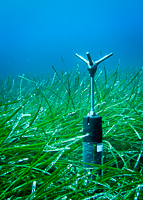
Two Acoustic Doppler Velocimeters (ADV) Vectrino, Nortek measuring wave action and flow velocities in a Posidonia seagrass meadow.

9. Field observations of wave-induced streaming through a submerged seagrass (Posidonia oceanica) meadow

Journal Papers
Luhar M, Infantes E, Orfila A, Terrados J, Nepf HM
Journal of Geophysical Research 118: 1-14
Publication year: 2013
Photo of Posidonia oceanica seedlings growing on sandy substrate in the Mediterranean Sea

5. Posidonia oceanica and Cymodocea nodosa seedling tolerance to wave exposure

Journal Papers
Infantes E, Orfila A, Bouma TJ, Simarro G, Terrados J
Limnology and Oceanography 56(6): 2223-2232
Publication year: 2011

34. Making realistic wave climates in low-cost wave mesocosms: a new tool for experimental ecology & biogeomorphology

Journal Papers
Infantes E, de Smit J, Tamarit E, Bouma TJ
Limnology and Oceanography: Methods, 19: 317-330
Publication year: 2021
Artificial seagrass on hydraulic flume at MIT

3. Wave induced velocities inside a model seagrass bed

Journal Papers
Luhar M, Coutu S, Infantes E, Fox S, Nepf H
Journal of Geophysical Research Vol. 115, C12, 1-15
Publication year: 2010

14. Seagrass blade motion under waves and its impact on wave decay

Journal Papers
Luhar M, Infantes E, Nepf H
Journal of Geophysical Research - Oceans, 122.
Publication year: 2017

39. Coastal ecosystem engineers and their impact on sediment dynamics: Eelgrass-bivalve interactions under wave exposure

Journal Papers
Meysick L, Infantes E, Rugiu L, Gagnon K, Boström C.
Limnology and Oceanography, 67(3): 621-633, doi: 10.1002/lno.12022
Publication year: 2022
Increased current flow enhances the risk of organic carbon loss from Zostera marina sediments: Insights from a flume experiment

17. Increased current flow enhances the risk of organic carbon loss from Zostera marina sediments: Insights from a flume experiment

Journal Papers
Dahl M, Infantes E, Clevesjö R, Linderholm HW, Björk M, Gullström M
Limnology and Oceanography, 63(6): 2793-2805.
Publication year: 2018

26. Role of eelgrass on bed-load transport and sediment resuspension under oscillatory flow

Journal Papers
Marin-Diaz B, Bouma TJ, Infantes E
Limnology and Oceanography, 65(2): 426-436
Publication year: 2020

Further reading on seagrass ecology