
AN UNDERWATER FLOWERING PLANT
Meet Cymodocea nodosa
Seagrasses are often confused with seaweeds, but they are true flowering plants. They have leaves, roots and rhizomes, and they reproduce through flowers, fruits and seeds while living entirely underwater.
In the Canary Islands, Cymodocea nodosa grows mainly on shallow sandy seabeds. Its leaves form canopies above the sediment, while roots and rhizomes spread below it. Together, these structures create the foundation of a complex coastal habitat.
WHY SEAGRASS MATTERS?
More than plants: an entire living habitat
Healthy seagrass meadows support coastal ecosystems in many interconnected ways. Their ecological value extends from the organisms living among their leaves to the sediment held beneath them.
- Habitat. Shelter and feeding grounds for fish, seahorses, crustaceans, molluscs and other marine life.
- Nursery areas. Protected spaces where juvenile animals can feed, grow and avoid predators.
- Biodiversity. A structurally complex ecosystem supporting species above, within and below the canopy.
- Stable seabeds. Roots bind sandy sediments while leaves slow water movement close to the bottom.
- Clearer water. Meadows trap suspended particles and help reduce repeated sediment resuspension.
- Blue carbon. Seagrasses capture carbon and can contribute to its long-term storage in coastal sediments.

WHY RESTORATION?
Recovery can be slow and restoration is challenging
Seagrass meadows can be damaged by declining water quality, coastal development, anchoring, dredging, altered sediments and repeated physical disturbance. Storms and other natural events can add further pressure. When a meadow becomes fragmented or disappears, natural recovery may take many years and is not always assured.
Active restoration can help initiate recovery, but planting is only the first step. Young plants must survive waves, currents, shifting sand, burial, erosion and grazing before they become established. A suitable method at one location may perform differently elsewhere.
This is why restoration must be treated as a scientific process: carefully tested, monitored over time and adapted to local environmental conditions.

THE PROJECT
What CYMO-BAR is studying?
CYMO-BAR is led by researchers from the University of Las Palmas de Gran Canaria through the ECOAQUA University Institute. The project evaluates approaches for restoring Cymodocea nodosa while seeking to minimise unnecessary impacts on existing healthy meadows.
Experimental restoration areas allow us to follow the transition from individual planted units to expanding vegetation patches. The technical methods remain under scientific evaluation, so this public page focuses on the project’s ecological aims rather than operational details.
Monitoring beyond the day of planting
Restoration does not end when plants are placed on the seabed. Repeated observations help us understand why some plants establish and spread while others do not.
- Plant survival and growth
- Development of new shoots
- Expansion of vegetation patches
- Sediment burial and erosion
- Environmental conditions
- Return of associated fauna
EARLY ECOLOGICAL RESPONSE
Nature is beginning to use the restored habitat
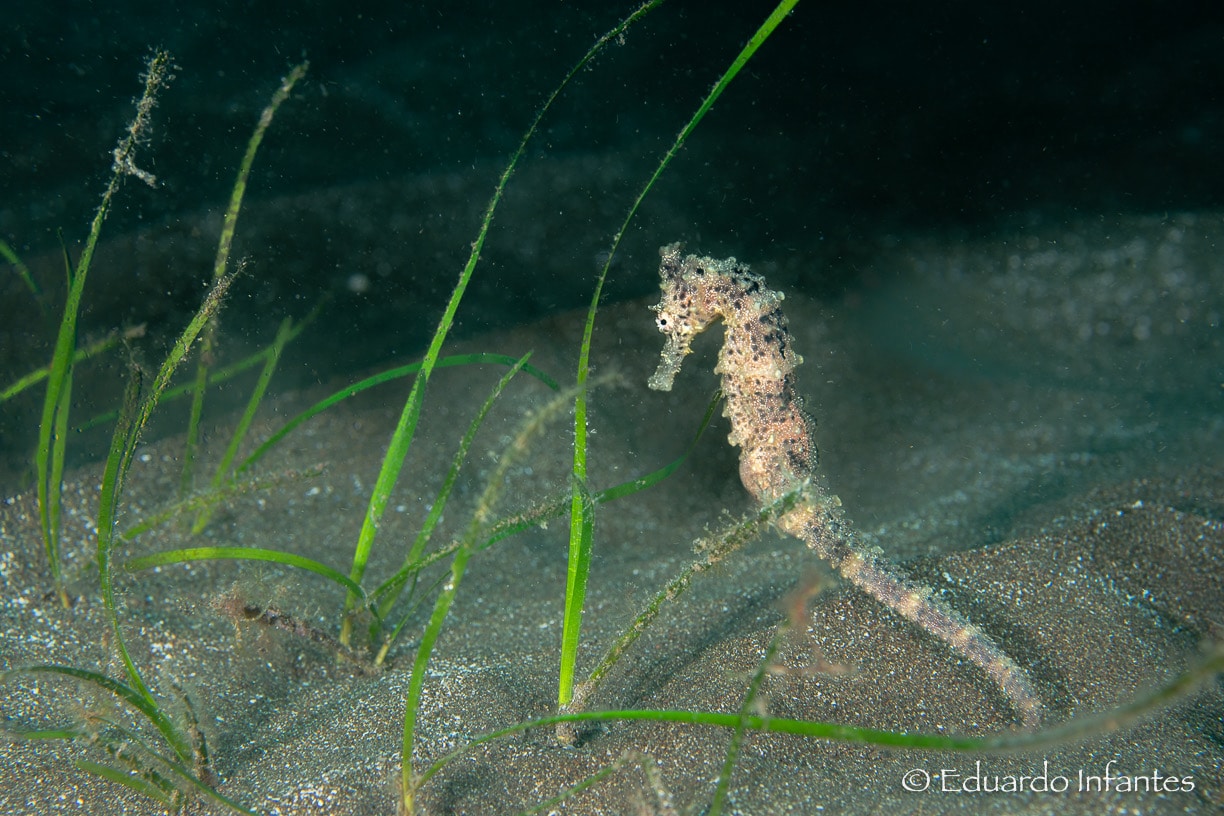
In one restoration area, many planted seagrass units have survived and continued to grow. Fish and invertebrates are using the developing vegetation, and seahorses have also been observed among the restored patches.
Seahorses rely on structurally complex habitats for shelter, feeding and places to hold on. Their presence is an encouraging indication that the restoration is already creating useful habitat. It does not mean that recovery is complete: the plants remain young, the site is still experimental and both the habitat and its wildlife are vulnerable to disturbance.
The long-term objective is a functioning meadow that can persist, expand and support a wider ecological community.

VISITING THE RESTORATION AREA
Please obvserve with care
Some restoration plots are accessible to recreational divers. Responsible observation helps protect young plants, marine wildlife and the integrity of ongoing scientific measurements.
- Stay outside the plots. Observe the restoration from beyond the marked experimental area.
-
Maintain neutral buoyancy. Do not kneel, stand or use your hands to stabilise yourself on the seabed.
-
Keep fins and equipment clear. Secure cameras, gauges and hoses, and avoid creating clouds of sediment.
-
Do not touch. Never move plants, markers or other scientific materials.
- Respect seahorses. Observe without touching, chasing, surrounding or blocking the animal.
-
Report concerns. Contact the research team if you notice damaged material or a potential hazard.
Further reading on seagrass ecology


Related scientific articles


Leave a Reply